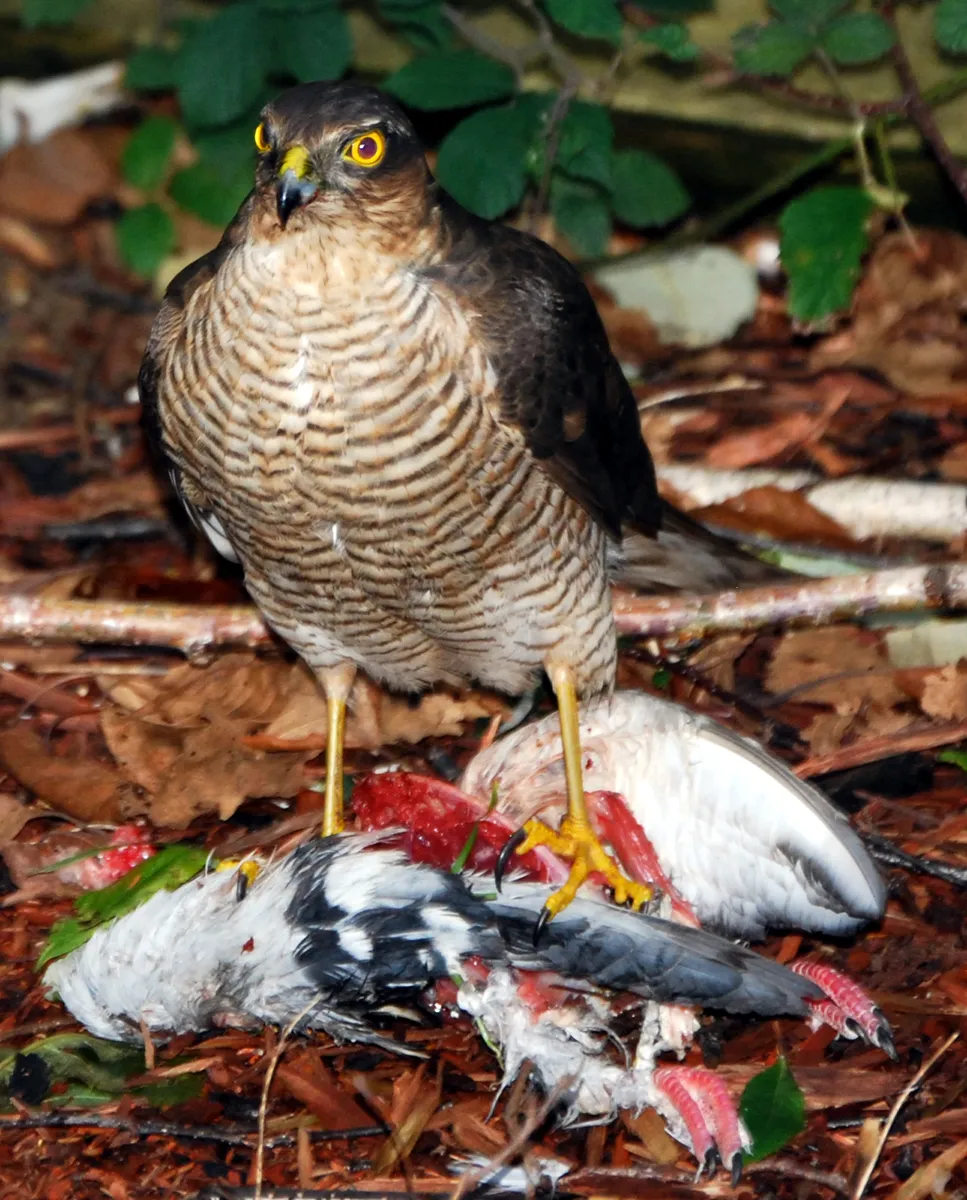
Eurasian Sparrowhawk
(Accipiter nisus)
Welcome to the Wildlife Wanderer species identification guide. This factfile covers the Eurasian Sparrowhawk (Accipiter nisus), a striking, small bird of prey found across the UK known for its long, bright yellow legs and the male's vibrant blue-grey upperparts.
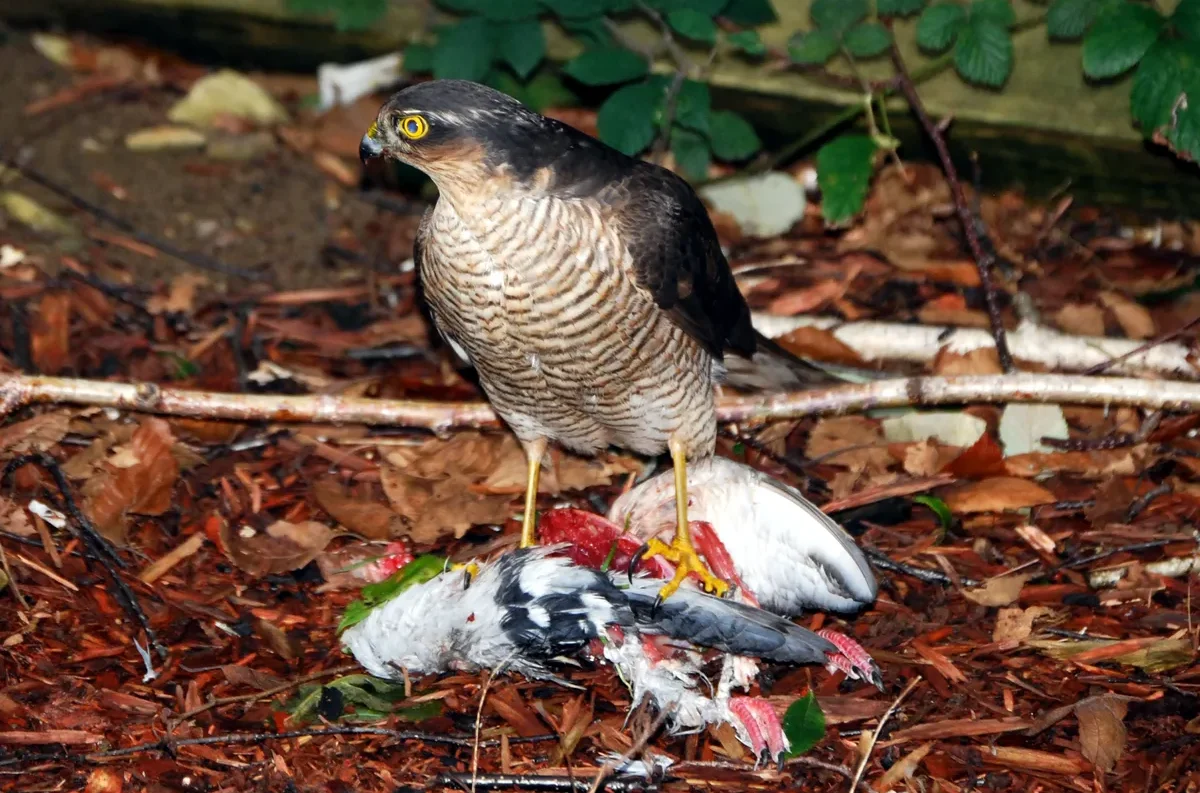
Eurasian Sparrowhawk (Accipiter nisus) with its pigeon prey.
Habitat & Distribution
- Diet: A specialized carnivorous predator that hunts almost exclusively small birds, such as finches, tits, and thrushes. Females are large enough to take down larger birds like pigeons and collared doves. They rely on ambush and speed to capture prey in flight or on the ground.
- Habitat: Woodlands, forests, orchards, and urban areas with plenty of tree cover, including suburban gardens where they frequently hunt around bird feeders.
- Distribution: Widespread across temperate and subtropical regions of Europe, Asia, and northwestern Africa.
- UK Distribution: Widespread and resident year-round throughout almost the entire UK, except for parts of the Scottish Highlands and islands.
- Rarity: Common.
Physical Description & Identification Keys
- Size: Male: 28–34 cm long with a 59–64 cm wingspan. Female: 35–41 cm long with a 67–80 cm wingspan.
- Description: The adult male features slate-grey or blue-grey upperparts and a finely cream-and-rufous horizontally barred breast, giving him a distinct warm pinkish glow from a distance. He has striking, bright orange-yellow eyes and a smaller, more compact frame.
- The female is significantly larger and heavier than the male (often up to 25% larger). She sports dark brown or grey-brown upperparts and a coarsely barred white chest completely lacking the male's rufous-pink tones. She features an obvious pale line or stripe above her fierce, bright yellow eyes.
- Juveniles look similar to adult females with brown upperparts, but their chest feathers are more vertically streaked or spotted rather than neatly barred. Both sexes feature exceptionally long, slender yellow legs armed with sharp black talons built for plucking prey out of the air.
Field Notes and Experiences
My first expericence with a Sparrowhawk was quite unnerving. A specimen had caught a sparrow (go figure) and as it attacked, the sparrow screamed its heart out. To this day I have never heard such a high-pitched scream for help.
The female depicted here was in my garden in Stoke Gifford, and it had already ripped out the pigoens chest, a signature move of the sparrowhawk, before I arrived. I t was placid and allowed me to get close, without any fear or threat. I took the photos, but deep down I felt remorse for the pigeon, to be attacked by such an impressive predator.
Six subspecies are recognised; A. n. nisosimilis, A. n. melaschitos, A. n. wolterstorffi, A. n. granti, A. n. punicus, and A. n. nisus, the European population. Sadly, no matter the population, it has always butted heads with humans. In the 19th Century it was seen as a pest, as it eagerly took poultry and game, and was heavily persecuted.
Recognised Subspecies
- Macaronesian Sparrowhawk (A. n. granti)
- Himalayan Sparrowhawk (A. n. melaschistos)
- Siberian Sparrowhawk (A. n. nisosimilis)
- Nominate Eurasian Sparrowhawk (A. n. nisus) - UK
- North African Sparrowhawk (A. n. punicus)
- Corsican Sparrowhawk (A. n. wolterstorffi)
Eurasian Sparrowhawk Similar Species Comparison
Distinguishing Features: The most similar lookalike species in the UK is the Eurasian Goshawk (Accipiter gentilis). The male Goshawk is vastly larger and bulkier than the male Sparrowhawk, closely matching a female Sparrowhawk in size. Goshawks can be distinguished by their heavier bills, much thicker and more powerful legs, a prominent white stripe above the eye, and a distinctly wedge-shaped or rounded tail in flight, unlike the Sparrowhawk's square-ended tail. The Common Kestrel (Falco tinnunculus) is another similar small bird of prey frequently seen in urban areas, but it is easily differentiated by its long, pointed wings and rhythmic hovering flight behavior. The Kestrel features a chestnut-brown back with black spots and completely lacks the horizontal chest barring characteristic of the Sparrowhawk.
Colour Forms and Hybrids:
- Albinism — Pure white plumage with pink eyes
- Leucism — Patchy or completely white plumage with dark eyes
- Melanism — Abnormally dark charcoal-black plumage
- Hybridisation with the Levant Sparrowhawk (Tachyspiza brevipes)