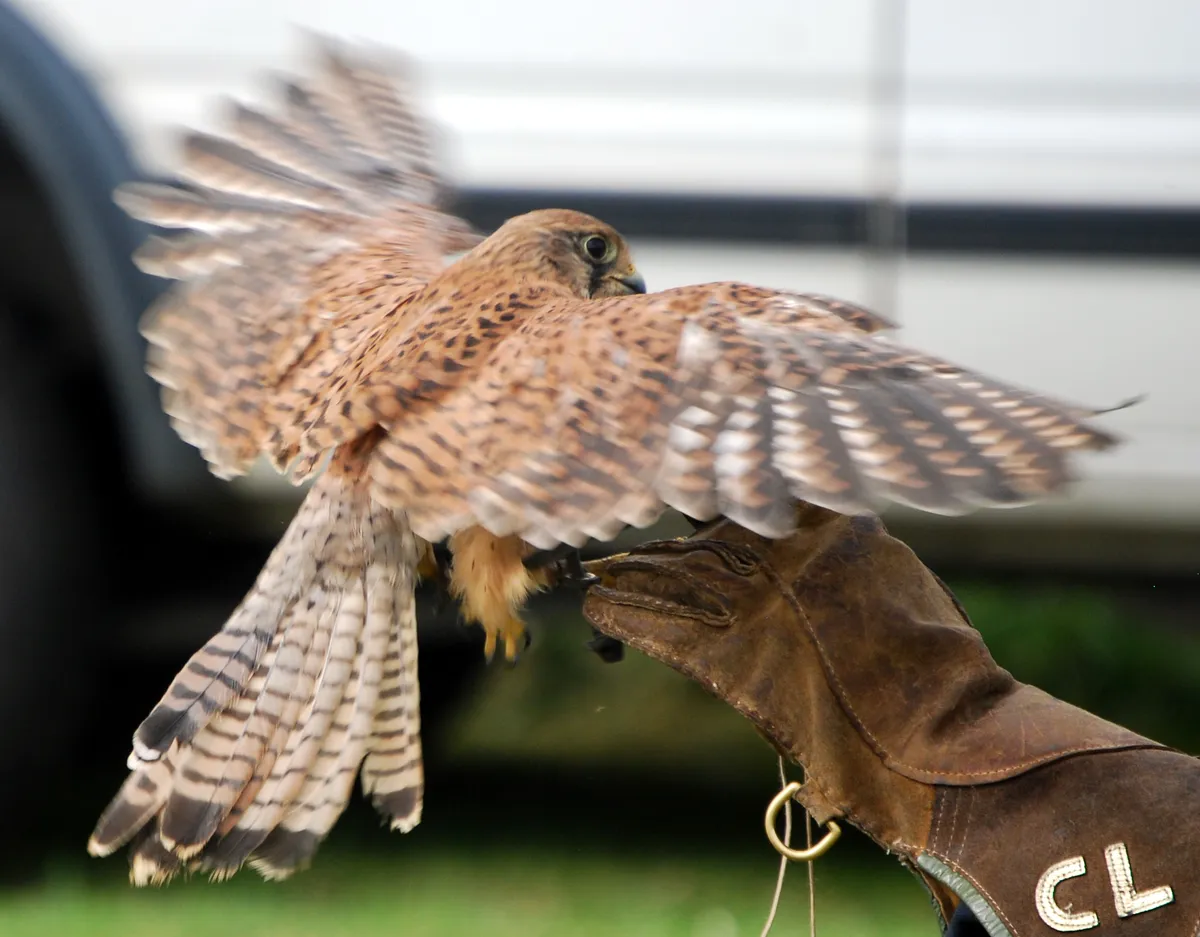
Common Kestrel
(Falco tinnunculus)
Welcome to the Wildlife Wanderer species identification guide. This factfile covers the Common Kestrel (Falco tinnunculus), a striking, small bird of prey found across the UK known for its long, pointed wings and its distinct ability to hover effortlessly in mid-air while hunting.
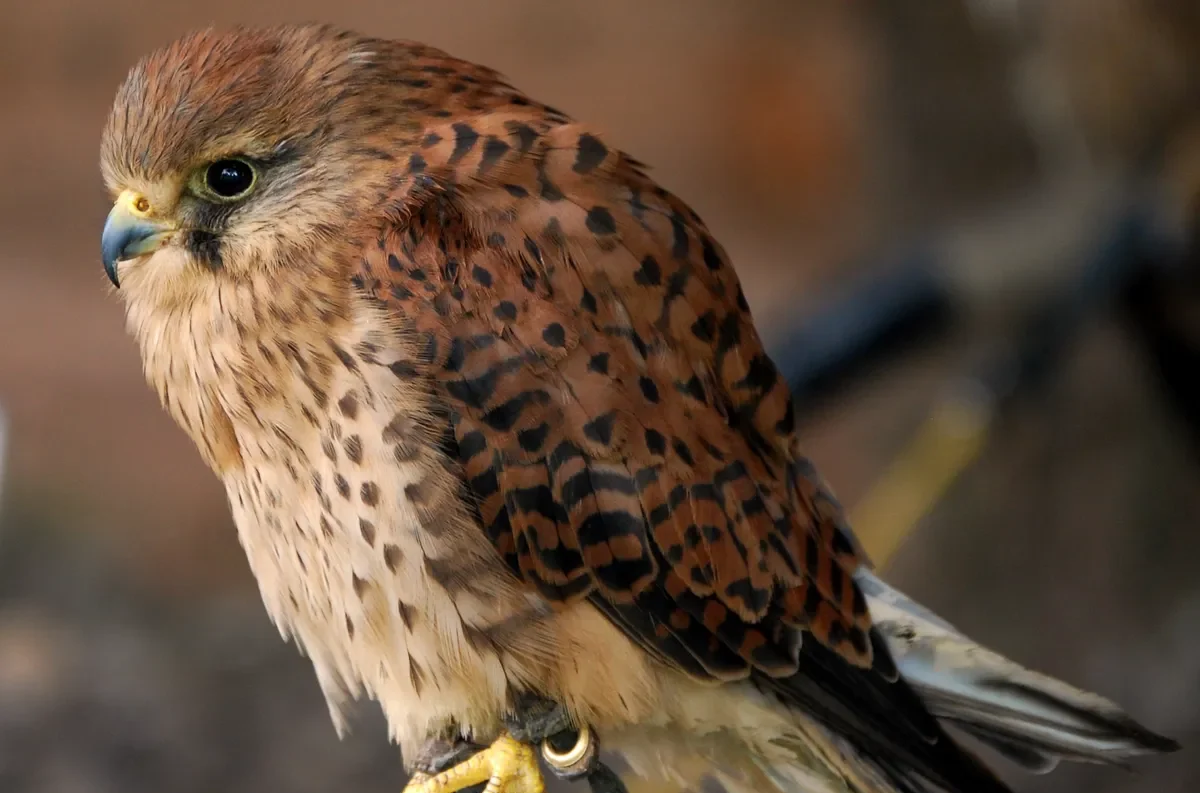
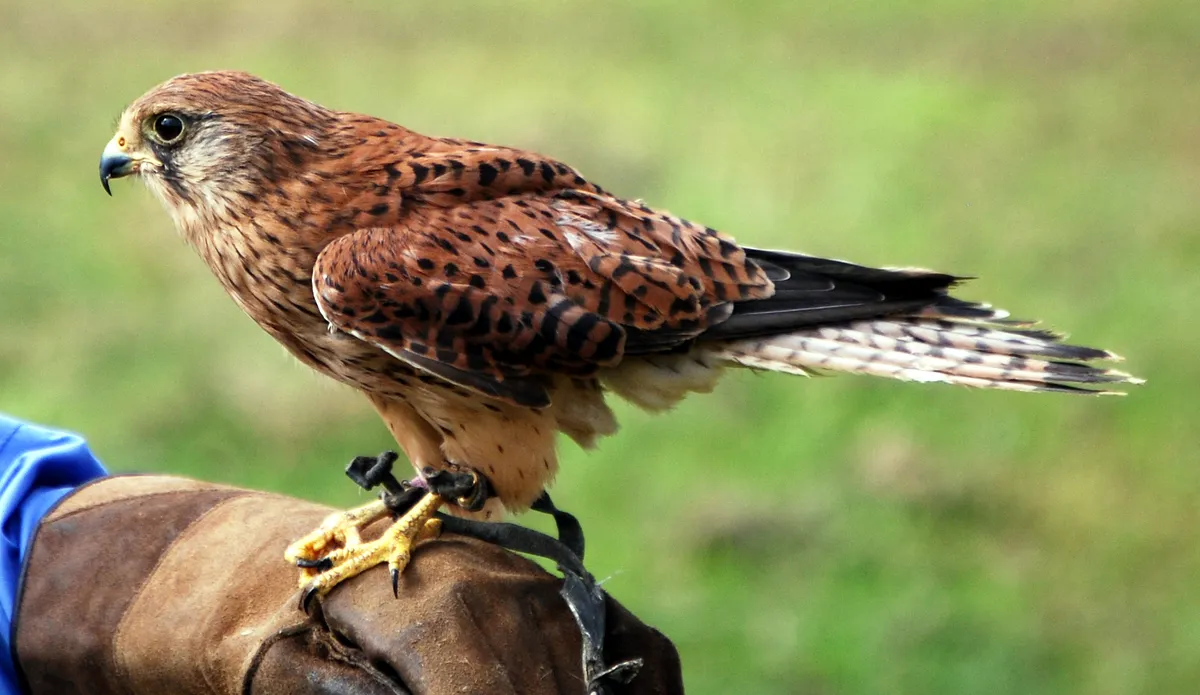
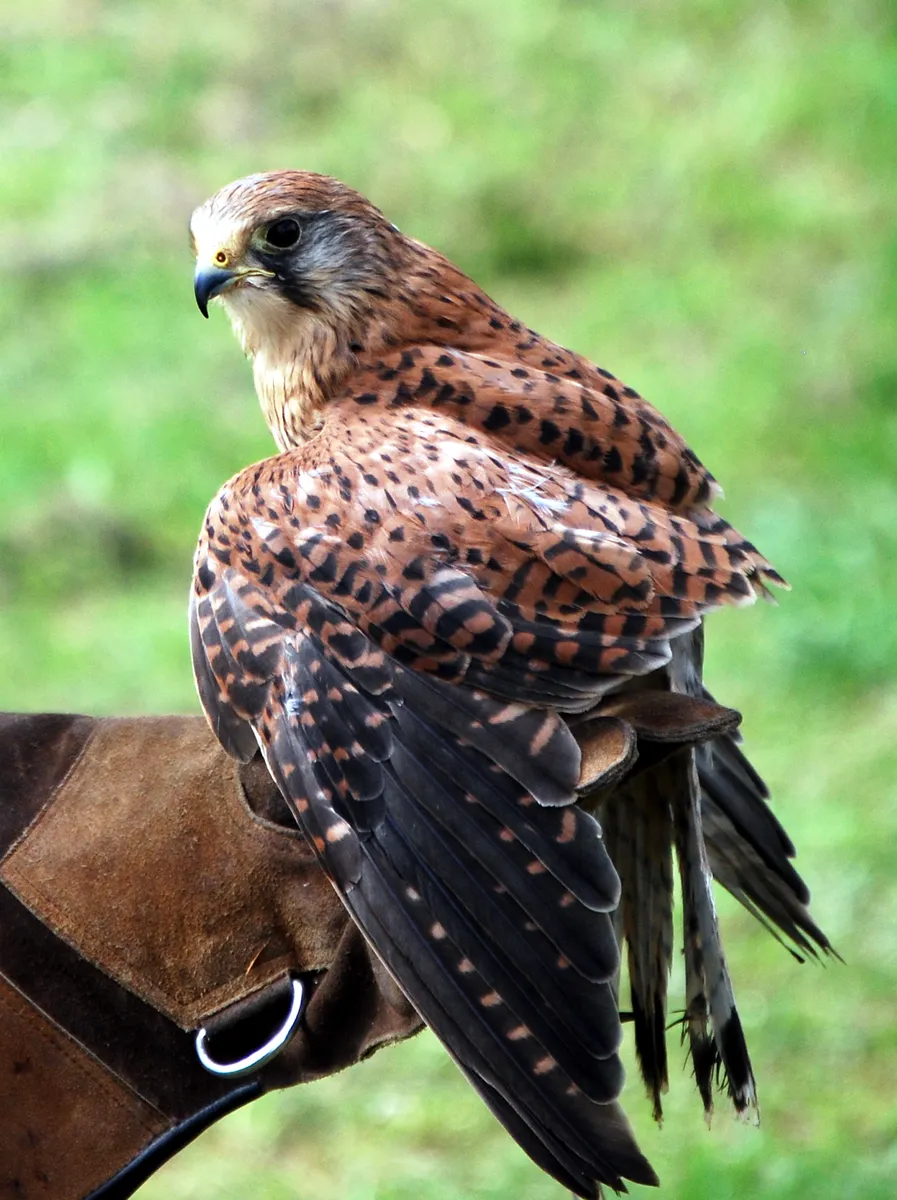
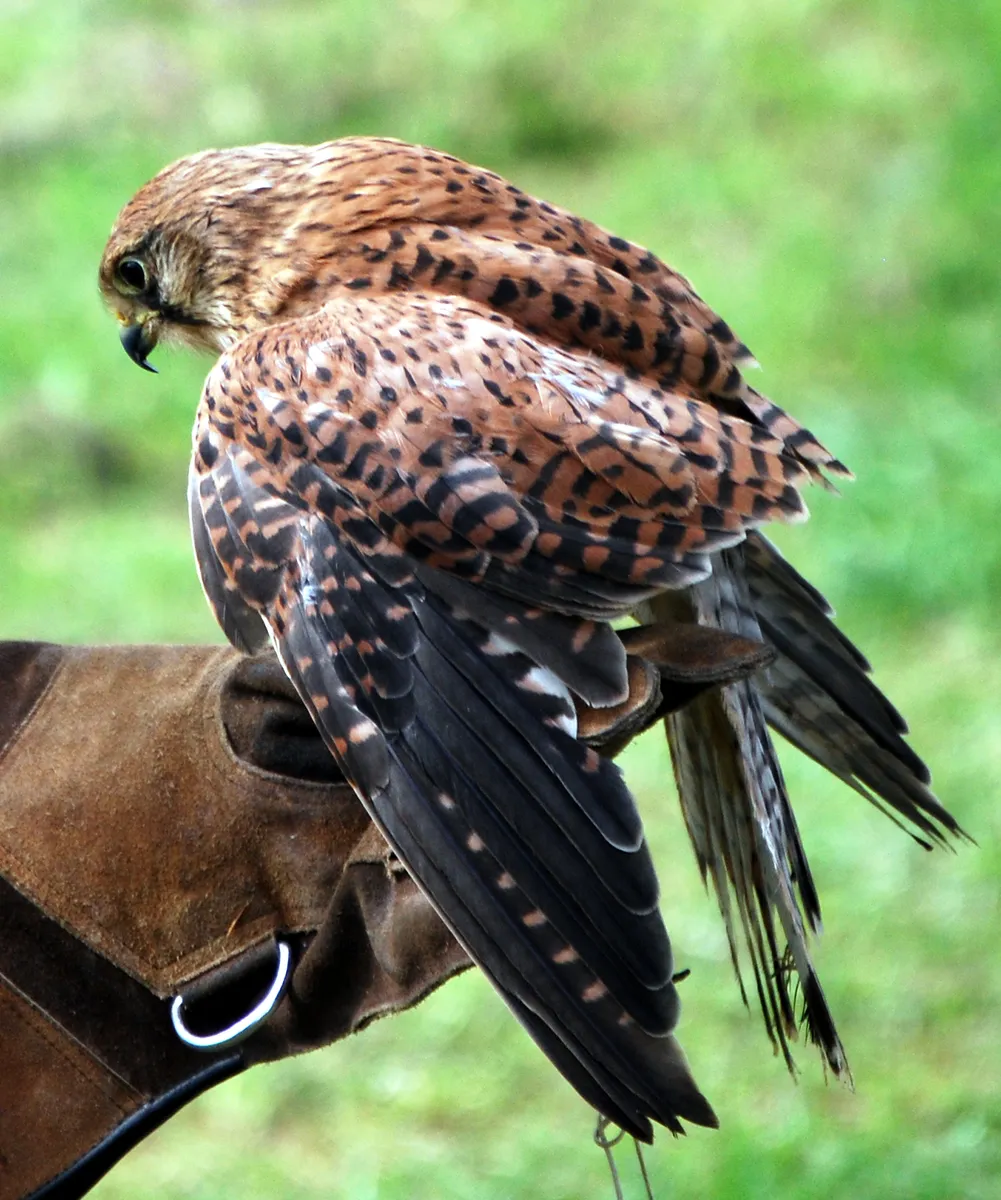
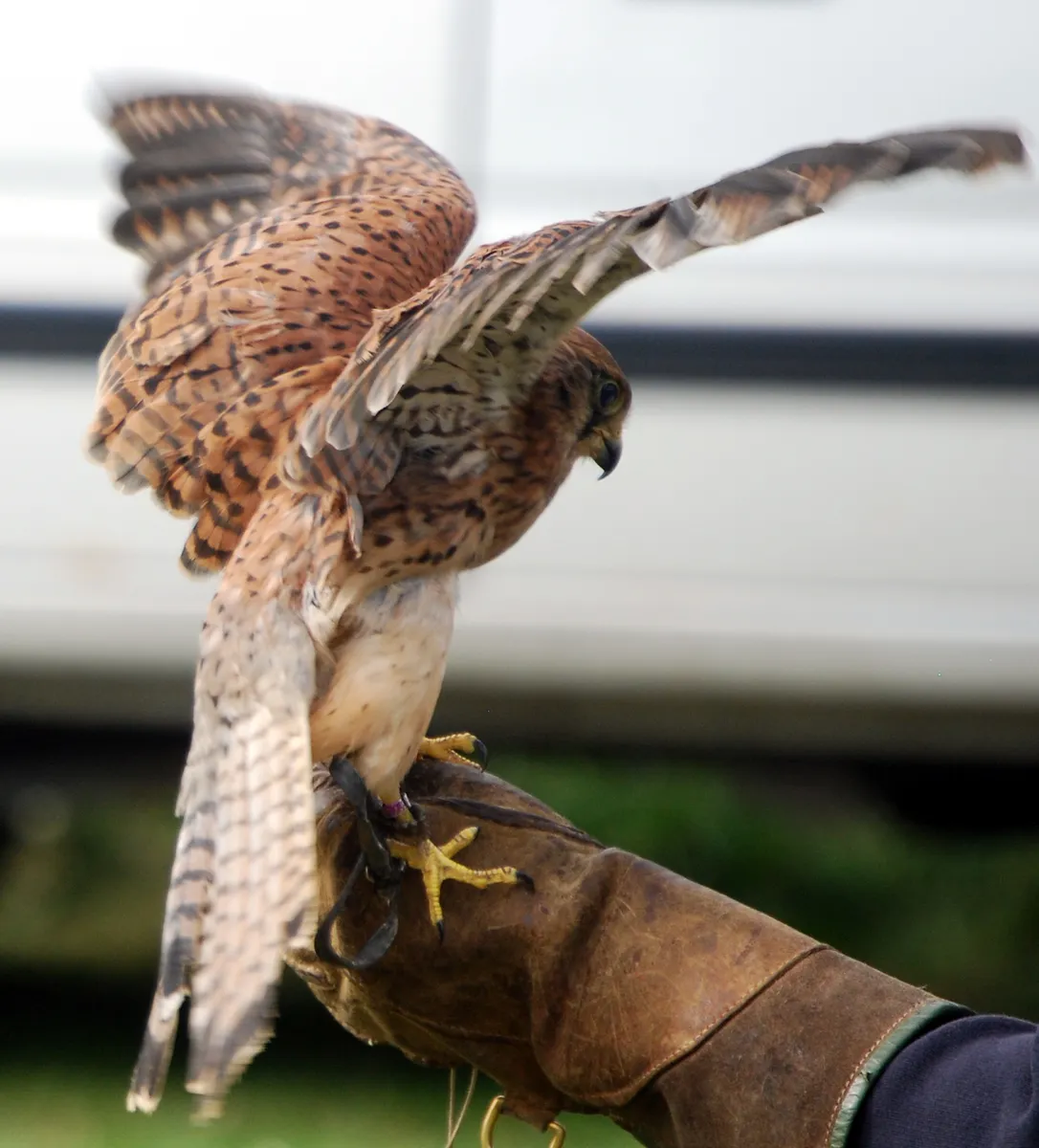
Common Kestrel (Falco tinnunculus) - Captive female
Habitat & Distribution
- Diet: Feeds primarily on small mammals, particularly field voles, mice, and shrews. They supplement this with large insects like beetles, and occasionally small birds or earthworms when mammals are scarce. They are famous for their unique ability to hover stationary in mid-air while scanning the ground below.
- Habitat: Open countryside, grasslands, heaths, moorlands, farmland, and roadside verges. They have also adapted well to urban environments, nesting on tall buildings, cliffs, and in large parks, but they generally avoid dense woodlands.
- Distribution: Widespread across Europe, Asia, and Africa.
- UK Distribution: Found year-round throughout almost the entire UK, absent only from Shetland and parts of the outer Scottish islands.
- Rarity: Common.
Physical Description & Identification Keys
- Size: Male: 32–35 cm long with a 65–74 cm wingspan. Female: 33–39 cm long with a 68–82 cm wingspan.
- Description: The adult male features a striking blue-grey head, a blue-grey tail with a prominent black terminal band, and a warm chestnut-brown back lightly peppered with small black spots. His underparts are a pale cream color, marked with delicate dark streaks. He has dark brown eyes ringed by a bright yellow orbital ring.
- Females are noticeably larger and heavier than the male. She sports a uniform rufous-brown coloration across her head, back, and wings, which is heavily patterned with dark brown spots and horizontal black barring. Her cream-colored chest is boldly marked with vertical dark brown streaks, completely lacking the blue-grey tones of the male.
- Juveniles closely resembles the adult female with a heavily barred, rufous-brown plumage, but the vertical streaks on the breast are broader, and the flight feathers feature distinct pale margins. Both sexes feature relatively short, yellow legs with strong talons, and a prominent dark vertical "moustache" stripe running down the cheek below their large, dark eyes.
Field Notes and Experiences
I have seen many kestrels hovering over fields as we pass down the motorway, but none up-close, other than captivity. Most recently I saw one above the school in which I work at Stoke Gifford, being pursued by a mob of angry crows.
With all my wild sightings, sadly, all my photos are of captive specimens.
Recognised Subspecies
- Greater Cape Verde Kestrel (F. t. alexandri)
- (F. t. archerii)
- Canary Islands Common Kestrel (F. t. canariensis)
- East Canary Islands Common Kestrel (F. t. dacotiae)
- (F. t. interstinctus)
- Lesser Great Cape Verde Kestrel (F. t. neglectus)
- Indian Common Kestrel (F. t. objurgatus)
- Siberian Common Kestrel (F. t. perpallidus)
- Rufescent Kestrel (F. t. rufescens)
- Egyptian Common Kestrel (F. t. rupicolaeformis)
- Common Kestrel (F. t. tinnunculus) - UK
The subspecies differ mainly in size and weight, mantle colour, wingtip whiteness, and leg colour.
Common Kestrel Similar Species Comparison
Distinguishing Features: The most common lookalike species in urban and open areas is the Eurasian Sparrowhawk (Accipiter nisus) . While similar in overall size, the Sparrowhawk can be immediately differentiated by its piercing, bright yellow-orange eyes, its short, rounded wings, and the clean, horizontal zebra-stripe barring across its chest. The Kestrel completely lacks this horizontal chest barring, featuring vertical speckling instead. Furthermore, the Kestrel is easily distinguished in flight by its long, pointed wings and iconic, stationary hovering behavior, whereas the Sparrowhawk relies on rapid, dashing ambush sprints from tree cover. The Eurasian Merlin (Falco columbarius) is another small, similar falcon, but it is more compact, flies with fast, low sweeps across open moorlands, and lacks the warm chestnut-brown coloration and rhythmic hovering behavior characteristic of the Kestrel.
Colour Forms and Hybrids:
- Albinism — Pure white plumage with red/pink eyes.
- Leucism — Symmetrical or patchy white plumage replacing brown tones
- Melanism — Abnormally dark charcoal to blackish plumage
- Hybridisation in captivity with the Merlin (Falco columbarius) and the American Kestrel (Falco sparverius)