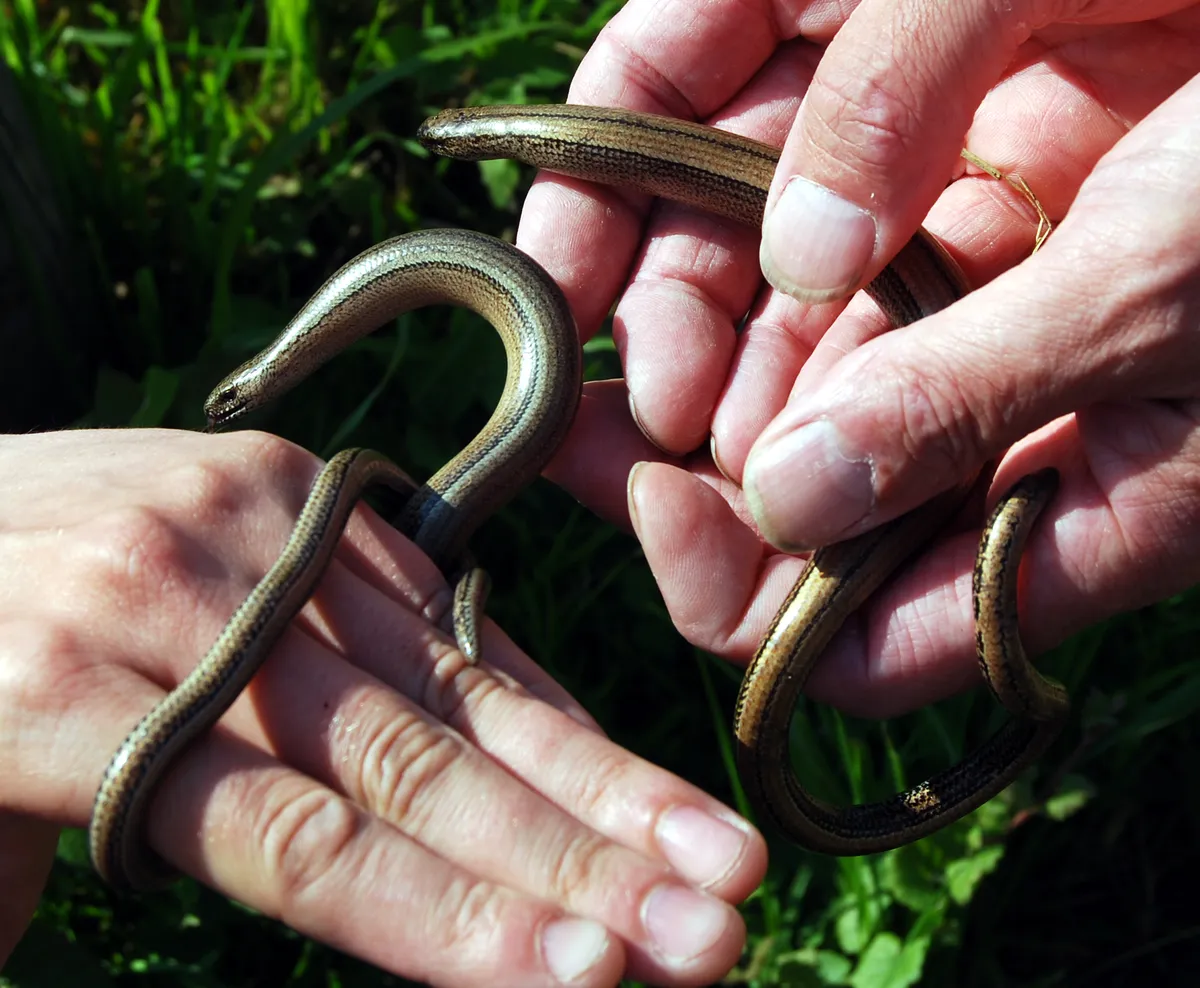
Common Slow Worm
(Anguis fragilis)
Welcome to the Wildlife Wanderer species identification guide. This factfile covers the Common Slow Worm (Anguis fragilis), a striking, legless lizard found across the UK known for its glass-smooth, metallic-sheened skin and its remarkable ability to drop its tail to escape predators.
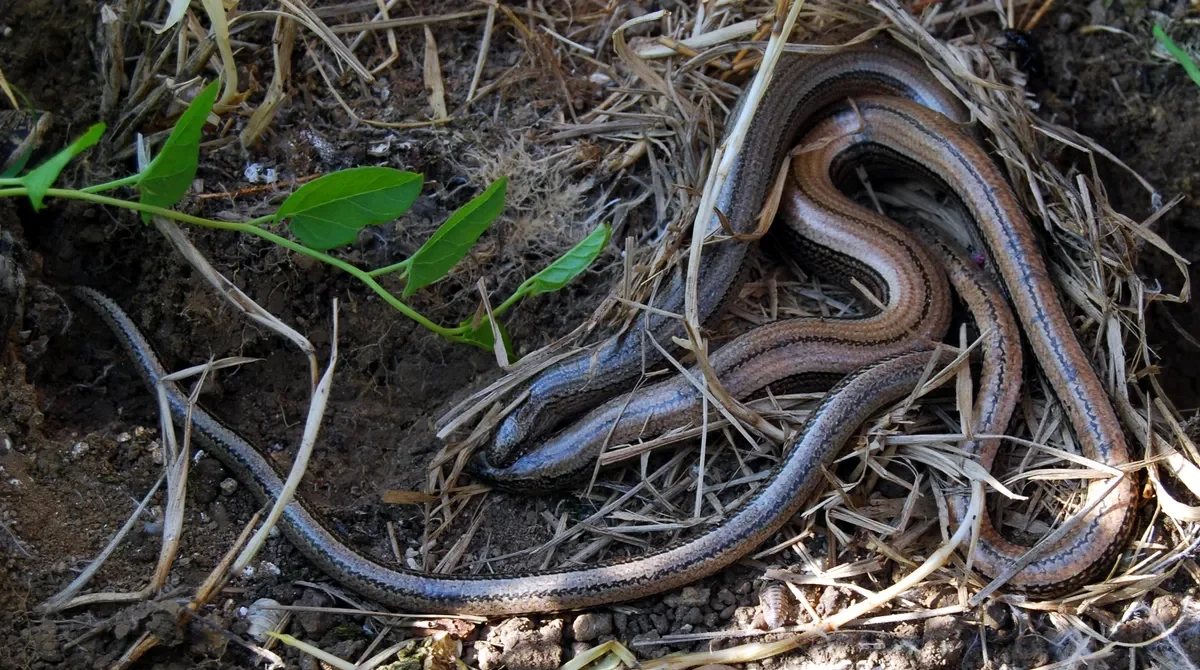
Two Common Slow Worms (Anguis fragilis) displaying their thin dark stripes.
Habitat & Distribution
- Diet: A carnivorous predator that hunts primarily in damp conditions. Its diet consists mostly of slow-moving invertebrates, with a heavy preference for slugs, snails, and earthworms. It also eats spiders, beetles, and insect larvae, using its backward-pointing teeth to firmly grip its slippery prey.
- Habitat: Overgrown habitats; damp and cool, such as woodlands, moorlands and scrubland.
- Distribution: Western and northern Europe, and parts of central Europe.
- UK Distribution: Widespread across most of Britain.
- Rarity: Common.
Physical Description & Identification Keys
- Size: 40-50cm long.
- Description: The most common British reptile, the Slow Worm is extremely slender and generally un-patterned. The base colour is usually bronze, copper or brown, but can vary to grey or silver, and it always has a metallic appearance. There is usually a longitudinal stripe along the back in females, flanked by darker sides, and the males can sometimes display small blue spots.
- Juveniles are golden brown in colour, and feature a longitudinal stripe, dark underbelly and dark sides.
Field Notes and Experiences
As a child, Slow Worms seemed to be everywhere. I found many under large stones in fields and other green areas, and at times in my own back garden. As an adult, my only encounters have happened a lot further out into the countryside, as if over time we have managed to force them further from the urban areas.
Slow Worms are a misnomer, as they are neither slow nor worms. They are a form of legless lizard, and like many lizard species they are capable of autotomy, shedding their tail when in danger. The tail will grow back, but it will be shorter and cannot be shed again. They are fully protected under UK law, making it illegal to kill, harm or sell them.
Ignorance may lead to misidentifications (long and scaly = snake) however, morphologically they are very different. My wife recalls a memory of saving a Slow Worm as a child, from other children putting it in the road and trying to get it run over.
Slow Worms are an extremely helpful species, ridding gardens of pests like slugs and snails. They can bite when threatened, however, it does not hurt or break the skin, and at most you may feel a small amount of pressure.
The largest specimens I have seen were encountered high up on a moorland area near Minehead. They measured around 40cm in length and had a girth of approximately 4.5cm. The specimens in the below photograph were being moved away from a road to a safer environment.
Common Slow Worm Similar Species Comparison
Distinguishing Features: The Slow Worm is very different from any other reptile in the UK. For one, it lacks the limbs of lizards, and it has a small head compared to its body, unlike the broader heads seen in snakes. It may be confused with the Barred Grass Snake (Natrix helvetica) but on closer inspection they are very different.
Colour Forms and Hybrids:
- Anerythrism — Dark charcoal to pale grey body (lacks red/brown tones)
- Erythrism — Bright copper, rust, or reddish-brown body
- Leucism — Cream-white body with normal dark eyes
- Melanism — Solid jet-black body
- Xanthism — Bright yellow to golden body color
- Hybridisation with the Eastern Slow Worm (Anguis colchica)
- Hybridisation with the Italian Slow Worm (Anguis veronensis)