
Thicklip Grey Mullet
(Chelon labrosus)
Welcome to the Wildlife Wanderer species identification guide. This factfile covers the Thicklip Grey Mullet (Chelon labrosus), a sturdy marine fish found across UK coastal waters. It is widely known for its silvery flanks, thick fleshy upper lip, and status as a common algae-grazing herbivore.
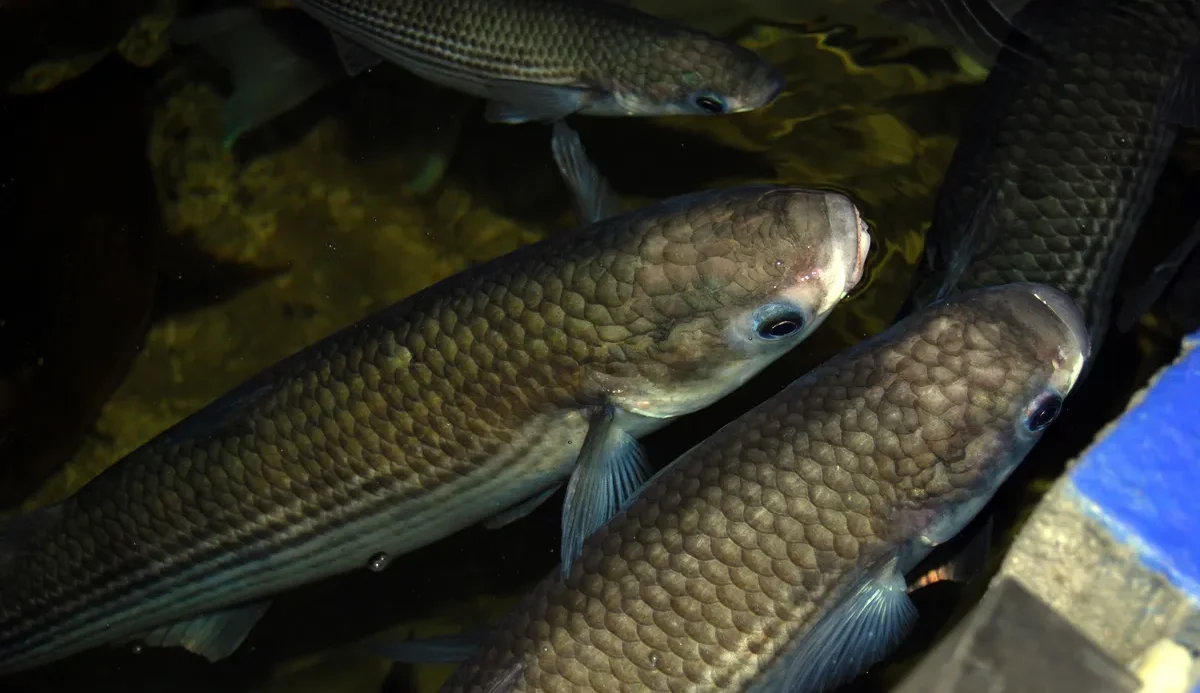
Captive Thicklip Grey Mullet (Chelon labrosus) showing their prominent scales.
Habitat & Distribution
- Diet: Primarily a herbivore and detritivore. It uses its thick upper lip to scrape microalgae, diatoms, and benthic invertebrates from rocks, harbor walls, and piers, occasionally ingesting small benthic crustaceans and worms.
- Habitat: Shallow coastal waters, harbors, marinas, estuaries, and tidal rivers (frequently entering brackish and almost fresh water to feed).
- Distribution: Across the Eastern Atlantic (from Iceland and northern Norway south to Senegal) and throughout the Mediterranean and Black Seas.
- UK Distribution: Widespread and common along all coasts of the UK and Ireland, especially around southern and western shores.
- Rarity: Common.
Physical Description & Identification Keys
Size: 30–60cm (can reach up to 75cm).
Description: Torpedo-shaped, stout body with a broad, flattened head and silvery sides with subtle dark longitudinal stripes fading to a white belly. It features two small, widely spaced dorsal fins—the first with just 4 short spines—and lacks a visible lateral line along the body. The upper lip is characteristically very thick, rubbery, and covered in small fleshy bumps (papillae), and the body is covered in large, coarse scales.
Field Notes and Experiences
I have never seen this species in the wild, and I forget where this captivity photograph was taken.
European Seabass Similar Species Comparison
Distinguishing Features: The Thicklip Grey Mullet is most commonly confused in UK waters with the European Seabass (Dicentrarchus labrax) . Both species share silvery scales and frequent the same coastal and estuarine habitats. However, adults are easily distinguished by their head and mouth shape. The Thicklip Grey Mullet has a blunt head, a small mouth, and a noticeably thick, rubbery upper lip. In contrast, the European Seabass features a pointed head with a large, tooth-bearing mouth. They also differ in their fins and markings. The Thicklip Grey Mullet lacks a visible lateral line entirely and possesses a small first dorsal fin with only 4 short spines. The European Seabass has a prominent, continuous lateral line along its flank, and its first dorsal fin is equipped with 8 to 10 sharp, rigid spines.
Colour Forms:
- Leucism & Albinism — Extremely rare color mutations documented in captive/aquaculture stocks; not established as wild color morphs