
Smooth Newt
(Lissotriton vulgaris)
Welcome to the Wildlife Wanderer species identification guide. This factfile covers the Smooth Newt (Lissotriton vulgaris), a striking, adaptable amphibian found across the UK known for its pale, orange-bellied underside densely covered in bold black spots.
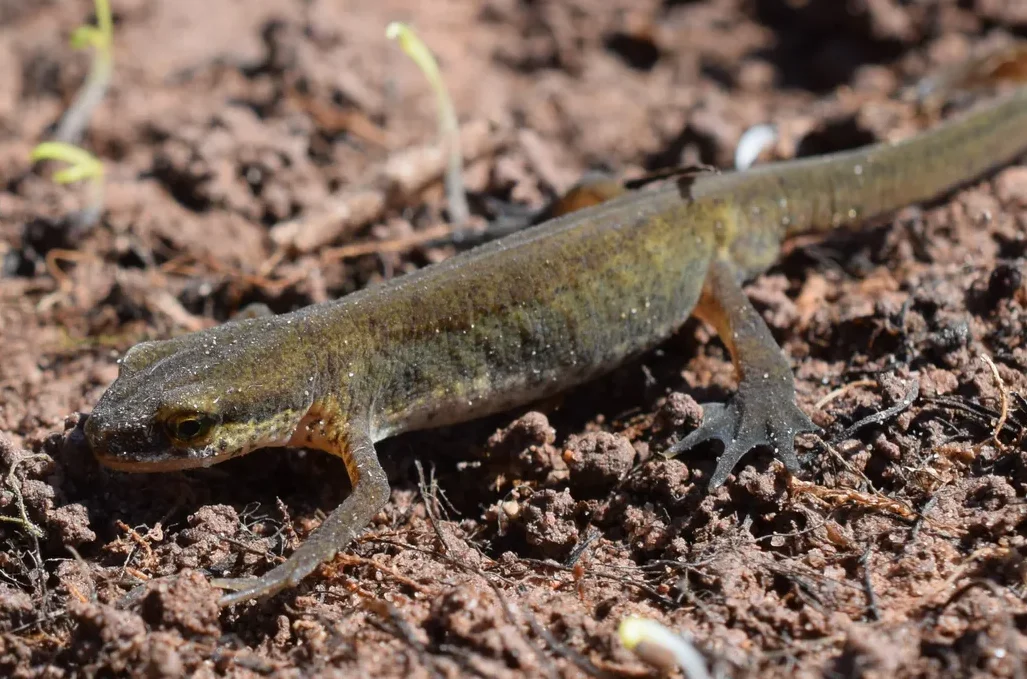
Profile view of a Smooth Newt (Lissotriton vulgaris) on a crumbly soil substrate.
Habitat & Distribution
- Diet: An opportunistic carnivore that hunts on land and in water. During its terrestrial phase, it searches for earthworms, slugs, snails, and insects. When breeding in ponds, its diet shifts to aquatic prey like water fleas, midge larvae, and amphibian tadpoles.
- Habitat: Ponds, shallow lakes, ditches, woodlands, heathlands, bogs, parks, gardens, agricultural areas.
- Distribution: Europe and parts of Asia. Introduced to Australia.
- UK Distribution: Widespread across most of the UK.
- Rarity: Common.
Physical Description & Identification Keys
- Size: 8-11cm.
- Description: The head is slightly longer than broad, with two to three longitudinal grooves. The body is long and slender and finishes in a long tapering tail. The colour varies between brown, olive, and ochre, or a combination of the three. The underside is white or cream with a conspicuous orange-red central stripe. The dorsal side is decorated in dark spots which are bigger in the larger males.
- The male's snout is rather blunt compared to the round snout of the female. The males also feature an orange stripe on the underside of the tail, and large dark spots along the underbelly and throat, these are smaller in females. During the breeding season, the males develop a large crest along their back and tail, decorated with dark vertical stripes. The head features five to seven longitudinal stripes. The lower edge of the tail, across the lower fin, features a red and blue flash with black spots. The females remain fairly drab and lack the crest. Juveniles are similar to the adults, but feature a pale orange dorsal stripe.
Field Notes and Experiences
Newts were always a welcome visitor to our ponds when we were children. As I grew older, they seemed rarer and it wasn't until I took a holiday to Looe that I saw one after a two-decade dry spell. I found it on the banks of a river, hidden under a stone in a moist, muddy area. My next encounter was in Center Parcs, on a late night stroll. But, my most recent was along the banks of a Brecon Beacons reservoir. Just as we had decided to leave, I saw a large stone, and had a gut feeling to turn it over. There, underneath, was an adult and a juvenile. Sadly, throughout these later encounters, I had thought I had seen both the Smooth and the Palmate Newt, but recent examination of the photographs showed they were all Smooth Newts.
Recognised Subspecies
- Romanian Spotted Smooth Newt (L. v. ampelensis)
- Italian Smooth Newt (L. v. meridionalis)
- Smooth Newt (L. v. vulgaris) - UK
The subspecies differ mainly in the male dorsal crest, body cross-section, hind-toe webbing and tail tip.
Smooth Newt Similar Species Comparison
Distinguishing Features: The Palmate Newt (Lissotriton helveticus) is very similar in appearance, however it always features an unspotted throat. In breeding males, the Palmate Newt has a very small crest, well developed webbing on the hind feet and a flash of blue on the underside of the tail, along with a fine tail filament. The Smooth Newt exhibits a large, continuous crest from head to tail, and it lacks the fine tail filament. During their terrestrial phase, both species appear near identical.
Colour Forms and Hybrids:
- Albinism — Pale yellow-pink skin with red eyes
- Leucism — Translucent white/pale cream skin retention with dark eyes