Peacock Butterfly
(Aglais io)
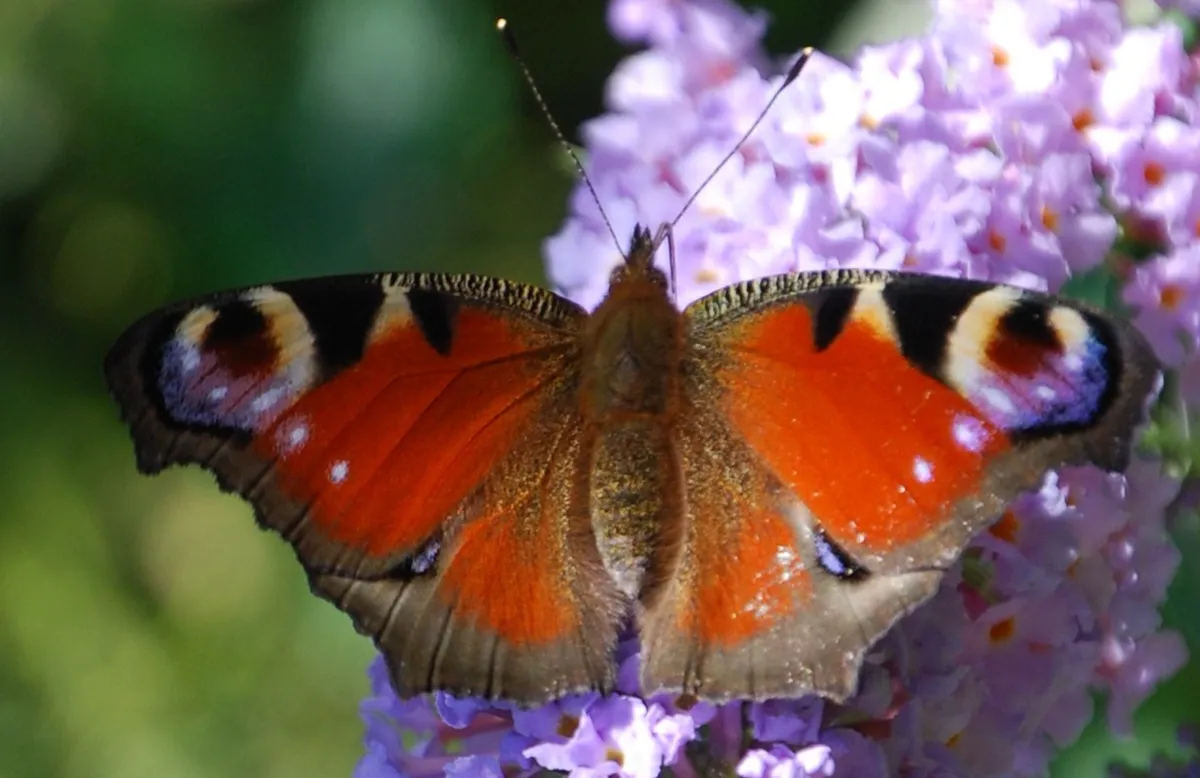
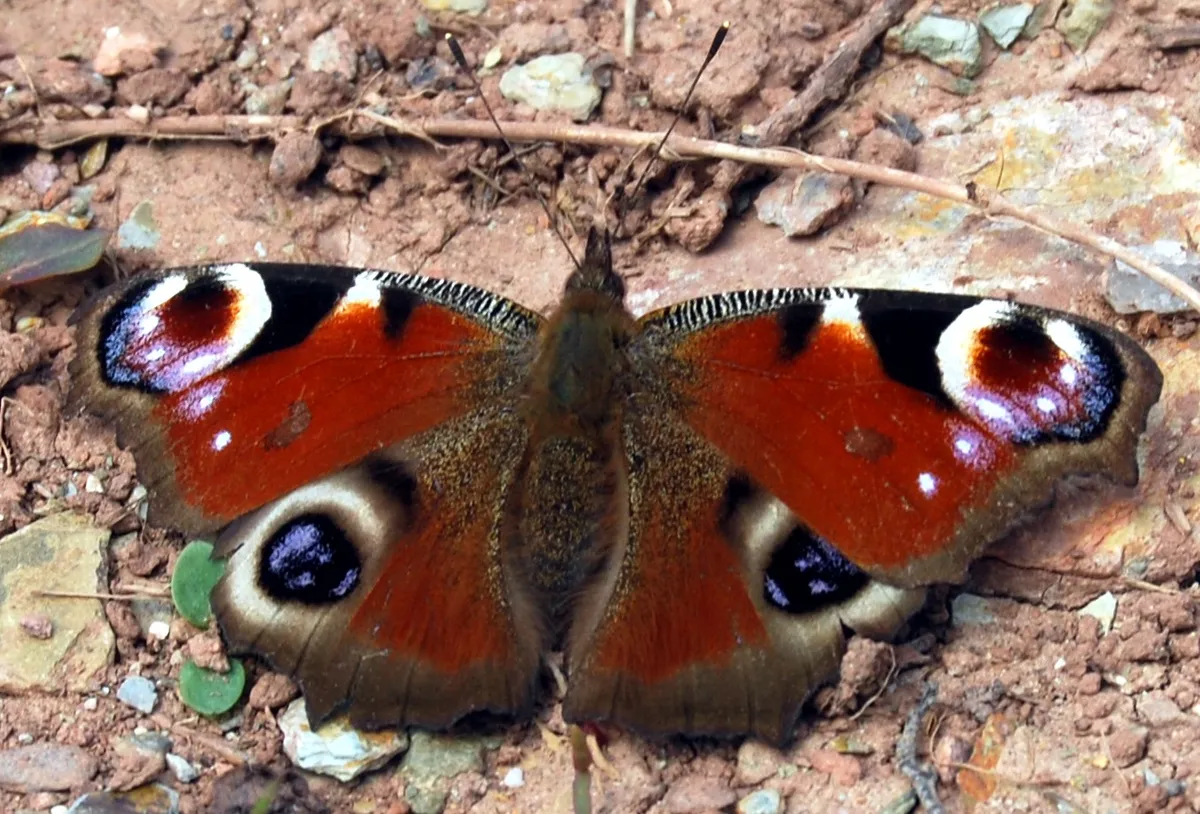
Welcome to the Wildlife Wanderer species identification guide. This factfile covers the Peacock Butterfly (Aglais io), a striking, colourful butterfly found across the UK known for the massive, iridescent blue-and-purple eyespots decorating its velvety crimson wings.
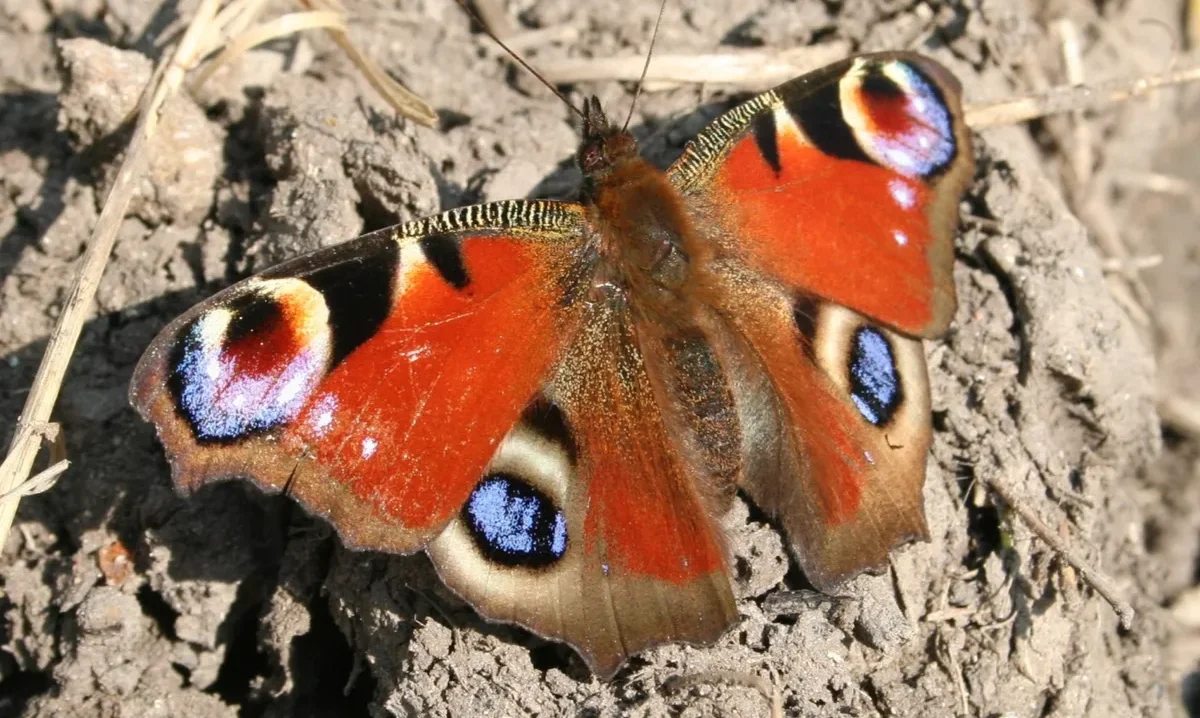
A large Peacock Butterfly (Aglais io) displaying its colourful eye-spots.
Habitat & Distribution
- Diet: The caterpillars feed almost exclusively on stinging nettles, eating the leaves in large communal groups. Adult butterflies sustain themselves on sugary nectar from wild and garden flowers, including buddleia, thistles, and hemp-agrimony, as well as tree sap and rotting fruit in autumn.
- Habitat: Found in gardens, meadows, fields, woodlands and wastelands.
- Distribution: Europe and temperate Asia.
- UK Distribution: Found throughout England and Wales and expanding into Scotland.
- Rarity: Common.
Physical Description & Identification Keys
- Size: Wingspan 50-65mm.
- Description: The scalloped forewings are a bright red, with a thick brown margin on the edges. The leading edge has a black and cream bars ending with a colourful eyespot (ocellus). The hindwings are similar, but feature a blue and black eyespot, lacking the yellow of the forewings. The body and head are brown in colour. The Peacock Butterfly can appear in many different forms, with varying degrees of colouration and saturation, and in some cases a very diluted eyespot.
- The underside is mostly brown, with an overlay of black and white wavy stripes.
- The caterpillar is black with white speckling and reddish prolegs. The back and sides are decorated in black branched spike tubercles.
Field Notes and Experiences
The Peacock Butterfly was a rare visitor to my childhood garden, and my encounters later in life seemed to be predominantly centred around fields and agricultural wasteland.
Recognised Subspecies
- Far Eastern Peacock Butterfly — (A. i. caucasica)
- Japanese Peacock Butterfly — (A. i. geisha)
- Nominate European Peacock Butterfly — (A. i. io) - UK
Peacock Butterfly Similar Species Comparison
Distinguishing Features: The Peacock Butterfly cannot be confused with any other UK species. While a pristine adult Peacock Butterfly is entirely unmistakable in the UK, heavily worn or damaged specimens resting with folded wings can occasionally be confused with the Small Tortoiseshell (Aglais urticae) , as it shares a similar rich red-orange colouration. However, the Small Tortoiseshell lacks the eye spots and features small blue crescents along its margins. The leading edges show alternating black and yellow bands. The Large Tortoiseshell (Nymphalis polychloros) is a larger and rarer version of the Small Tortoiseshell.
There are a few similar caterpillars in the UK, but these all exhibit yellow markings or yellow branched tubercles.
Colour Forms and Hybrids:
- ab. antigone (Extended-costa) — Costal blotch invades forewing ocellus; hindwing ocellus split
- ab. belisaria (Melanic-eyed) — Fused costal spots; hindwing ocelli replaced by dark cloud
- ab. brunnea (Chocolate) — Chocolate-brown ground color replacing deep wine-red
- ab. cyanosticta (Blue-spotted) — Extra blue spots outside main ocelli
- ab. dyophthalmica (Double-eyed) — Secondary smaller ocelli next to main hindwing eyespots
- ab. exoculata (Blind-eyed) — Blue pupil of hindwing ocelli completely missing
- ab. extrema (Total Melanic) — Solid soot-black wings with all markings obliterated
- ab. fischeri (Submarginal-blue) — Forewing ocellus red-brown; row of blue submarginal dots
- ab. fulva (Tawny) — Pale salmon-tawny ground color
- ab. iocaste (Black-scaled Costa) — Yellow costal spaces replaced by dark scaling
- ab. irenea (Extra-spotted) — Extra black spot near forewing inner margin
- ab. mesoides (Split-ocellus) — Forewing ocellus split by black veins
- ab. nigriocellata (Dark-centered) — Ocelli centers heavily suffused with black
- ab. ochreata (Ochre) — Ground color faded to dull ochre-yellow
- ab. prochnovi (Merged-costa) — Costal spots united, invading upper half of ocellus
- ab. semi-ocellata (Split-spot) — Hindwing ocellus split into two distinct spots
- ab. teloides (Continuous-blue) — Forewing ocellus forms an unbroken blue band
- Hybridisation with the Small Tortoiseshell (Aglais urticae) and the Camberwell Beauty (Nymphalis antilopa) - both within lab conditions.
There are many more recorded aberrations, however, the ones appearing here are the only validated forms.