Small Tortoiseshell
(Aglais urticae)
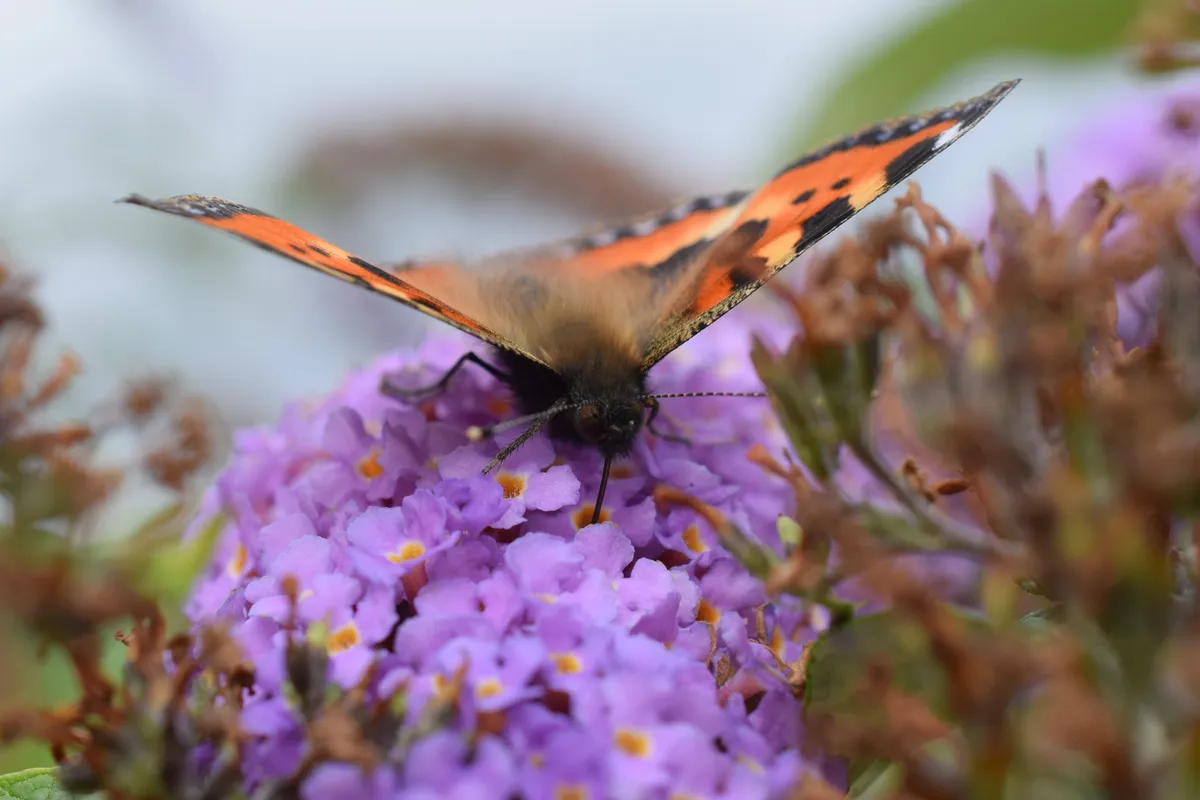
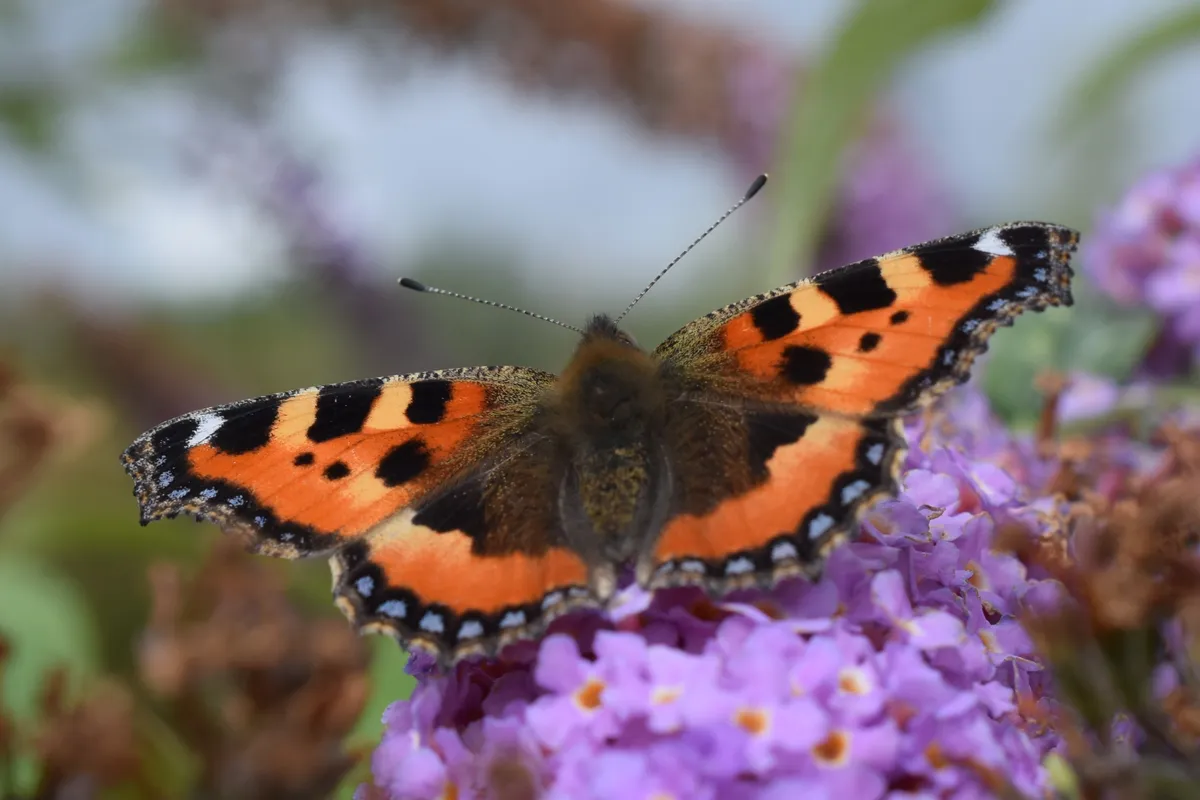
Welcome to the Wildlife Wanderer species identification guide. This factfile covers the Small Tortoiseshell (Aglais urticae), a striking, colourful butterfly found across the UK known for its fiery orange-and-black wings fringed with a brilliant row of iridescent blue spots.
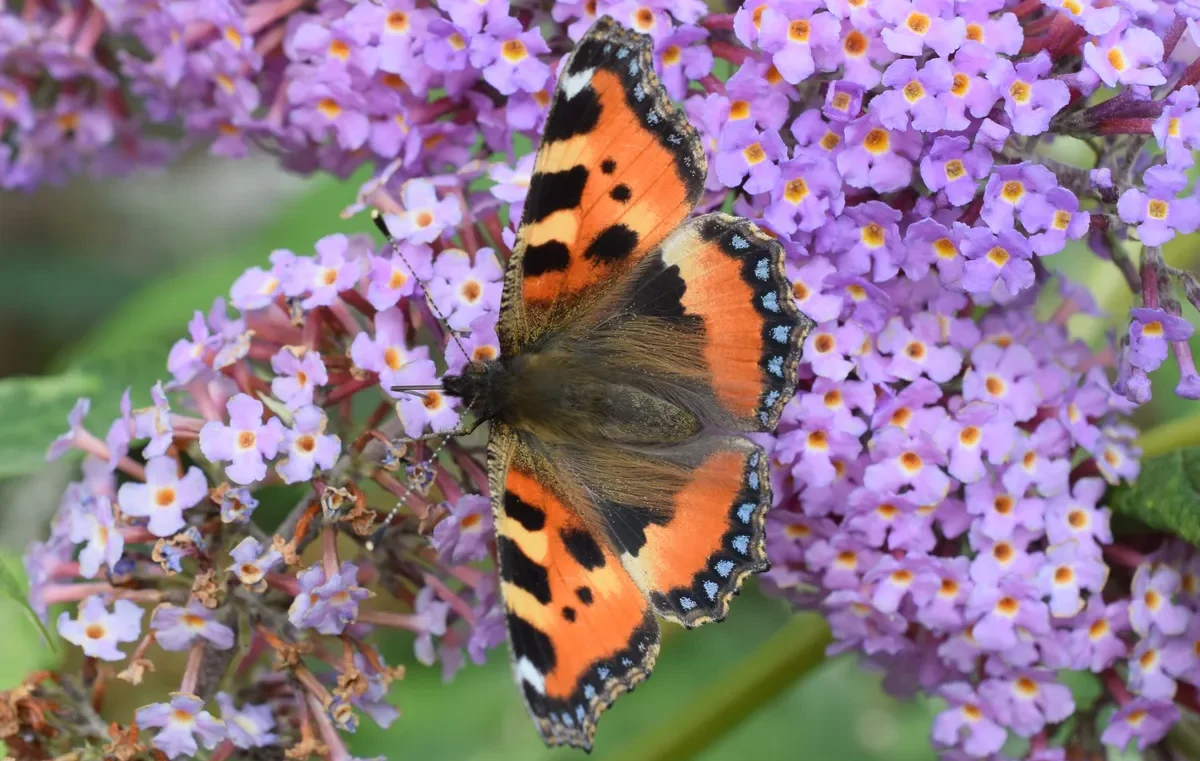
A rusty-red Small Tortoiseshell (Aglais urticae) feeding on a Buddleia.
Habitat & Distribution
- Diet: The caterpillars consume the leaves of stinging nettles, their primary host plant. Adult butterflies sustain themselves on nectar from a wide variety of flowers, including buddleia, thistles, and brambles.
- Habitat: Found in gardens, meadows, fields, and almost any open or semi-open space.
- Distribution: Europe and Asia.
- UK Distribution: Found across all of the UK.
- Rarity: Common.
Physical Description & Identification Keys
- Size: Wingspan 45-60mm.
- Description: The wings are predominantly a bright red-orange. The forewings exhibit large, black and yellow markings along leading edges, finishing with a white flash at the wing tips. Each forewing exhibits two small black spots and one large spot. Both sets of wings become brown towards the body and feature blue crescent markings along their margins. The body and head are a uniform brown colour, with black and white banded antennae finishing with a white tip.
- The underside is mostly dark brown, with a beige area on the forewings and a medium brown band on the hindwings.
- The caterpillar is predominantly black with yellow stripes running along its sides. The body is covered in black and yellow branched spines.
Field Notes and Experiences
The Small Tortoiseshell was a frequent visitor to my parents' garden, specifically on the Buddleia. I also encountered some on a very small growth of Buddleia growing on the banks of the Pontsticill Reservoir in the Brecon Beacons.
Recognised Subspecies
- Baikal Small Tortoiseshell — (A. u. baicalensis)
- Chinese Small Tortoiseshell — (A. u. chinensis)
- Connected Small Tortoiseshell — (A. u. connexa)
- Amur Small Tortoiseshell — (A. u. eximia)
- Gansu Small Tortoiseshell — (A. u. kansuensis)
- Polar Small Tortoiseshell — (A. u. polaris)
- Szechuan Small Tortoiseshell — (A. u. stoetzneri)
- Levantine/Southern Small Tortoiseshell — (A. u. turcica)
- Nominate European Small Tortoiseshell — (A. u. urticae) - UK
Small Tortoiseshell Similar Species Comparison
Distinguishing Features: In the UK, the Small Tortoiseshell is similar to the re-established Large Tortoiseshell (Nymphalis polychloros), and both were once classified in the same genus, Nymphalis. The Small exhibits uneven spots on the forewing, whereas the Large has two small black spots and two large black spots, it is also larger in size. The blue crescent markings are massively reduced in the Large and can be missing altogether. The Small is vividly coloured, whereas the Large is a lot duller in comparison, and features less brown on the upper side of the hindwings, the Large also lacks the white flash on the wing tips. The underside of the Large's hindwings show a consistent brown colouration with varying degrees of brown and dark brown marbling.
The Scarce Tortoiseshell (Nymphalis xanthomelas) has four black spots on the forewing and the first dark bar from the wings leading edge appears as two conjoined spots, as opposed to an actual bar in the Small.
The Painted Lady (Vanessa cardui) is duller in colour, a darker area around the wing tips, decorated with white spots, and lacks the blue crescent pattern along the margin.
Colour Forms:
- ab. adumbrata (Dark-banded Aberration) — Hindwing red band clouded with black
- ab. alba (White Aberration) — Pure white ground color
- ab. albapicta (White-patched Aberration) — White patches across normal orange ground color
- ab. angustibalteata (Narrow-banded Aberration) — Hindwing red band abnormally narrow
- ab. asi-ichnusa (Dark-based Aberration) — Forewing base extensively darkened
- ab. astride (Yellow-spotted Aberration) — Pale yellow spot in center of forewing
- ab. atrebatensis (Dark-suffused Aberration) — Joined costal spots; hindwings mostly black-brown
- ab. bellieri (Melanic-suffused Aberration) — Heavy dark suffusion; merged costal spots
- ab. biobsoleta (Twin-spotless Aberration) — Both forewing discal spots missing
- ab. brunneoviolacea (Violet-brown Aberration) — Ground color dull brownish-purple
- ab. clarirufa (Unspotted Red Aberration) — Clear, unspotted fiery red ground color
- ab. conjuncta (Barred-costa Aberration) — All three costal black spots merged into a bar
- ab. fervida (Fiery-red Aberration) — Deep, fiery fox-red ground color
- ab. flavofasciata (Yellow-banded Aberration) — Yellow apical patch extended into a complete band
- ab. fulva (Tawny Aberration) — Dull salmon/tawny-brown ground color
- ab. ichnusoides (Extreme Melanic Aberration) — Merged costal spots, missing discal spots, solid black hindwings
- ab. ignea (Bright-red Aberration) — Vivid red-orange ground color
- ab. implumis (Greasy-scale Aberration) — Defective scales creating a translucent purplish look
- ab. irenea (Extra-spotted Aberration) — Additional small black spot near forewing inner margin
- ab. leodiensis (Merged-costa Aberration) — Upper costal spots fused; discal spots missing
- ab. lucia (Grey-costa Aberration) — Greyed costal spaces; black hindwings with faint red trace
- ab. lutea (Straw-yellow Aberration) — Pale straw-yellow ground color
- ab. magnilunulata (Large-blue-spotted Aberration) — Abnormally enlarged blue marginal lunules
- ab. magnipuncta (Large-spotted Aberration) — Forewing discal spots abnormally enlarged
- ab. neorodes (Black-veined Aberration) — Wing veins across red areas broadly black
- ab. nigricaria (Black-hindwing Aberration) — Fused upper costal spots; hindwings solid black-brown
- ab. nigrita (Sooty Aberration) — Heavy soot-like black scaling across all wings
- ab. pallens (Sun-bleached Aberration) — Faded red-brown ground color with washed-out markings
- ab. pallida (Pale Aberration) — Extremely pale straw-white ground color
- ab. parvilunulata (Reduced-lunule Aberration) — Blue submarginal lunules tiny or absent
- ab. parvipuncta (Small-spotted Aberration) — Forewing discal spots drastically reduced
- ab. polaris (Sub-arctic-pattern Aberration) — Black bar connecting middle costal spot to inner margin
- ab. pseudoconnexa (Thick-barred Aberration) — Central costal spot joined to inner margin by a broad bar
- ab. radiata (Rayed Aberration) — Pale yellowish rays running outward to wing margins
- ab. semiichnusoides (Semi-melanic Aberration) — Merged costal spots; hindwings black except near anal angle
- ab. seminigra (Half-darkened Aberration) — Fused upper costal spots; blue lunules reduced to three
- ab. strigata (Streak-marked Aberration) — Horizontal black streak between costal spot and inner margin
- ab. subtusbrunnescens (Brown-underside Aberration) — Undersides uniformly dark brown, lacking normal pattern contrast
- ab. unipuncta (Single-spotted Aberration) — Only one of the two forewing discal spots present
- Hybridisation with the Peacock Butterfly (Aglais io) - within lab conditions.
Historically, there are at least 105 identified aberrations, however, the ones appearing here are the only validated forms.